
When is an All-in-One Printer a Good Choice?
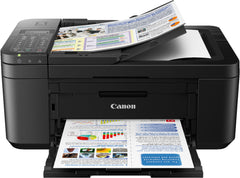
All-in-One printers (also known as AIOs or MFPs - multi-function printers) combine the features of multiple devices in one package. At its simplest, an All-in-One printer offers a laser or color inkjet printer combined with a scanning unit so that it can act as a printer, a scanner, and a copier. Many All-in-One devices also have the capability of sending and receiving faxes, scanning slides or sending emails, and downloading photos directly from your camera via memory card, which make them very useful for home offices and small businesses.
For example, you can scan documents and either store them in your PC or print them out immediately (so that the device acts as a copier). You can also scan documents and either send them to your PC for faxing, or fax them directly from the multifunction printer. And because all these functions are contained in one unit, you save space, and don't have to deal with multiple connections.
Is it better to purchase a separate printer, copier, scanner and fax machine, or an All-in-One device? Each route has its advantages.
Advantages of Purchasing an AIO Printer
- All-in-One printers offer more features for the price
- Multiple office functions are combined in one unit, with one connection
- One machine takes up less space - a real consideration if your office space is small
- A multifunction printer is more efficient - it reduces the number of separate pieces of equipment you need within reach by performing several tasks in one spot
- An All-in-One printer will probably cost less than buying multiple devices - they typically cost between $100 and $1,000
Disadvantages of an AIO Printer
- Networking can sometimes be an issue. Most home AIOs - particularly inexpensive models - will connect only to a single computer, and only by a USB cable. If there is more than one printer that will be networked, make sure that all the AIO's functions actually work over the network. It's not unusual for network features to be limited to printing, so you can't scan or fax, for example, unless you're directly connected to the AIO by a USB cable.
- Repairs are inconvenient - If one of the functions needs to be repaired you will be deprived of all office machines while the printer is in the repair shop.
- Compromised Functionality - While all the functions of an All-in-One device may perform adequately, some may not perform as well as you'd find with a dedicated unit. Some users feel that you basically get a weaker printer, scanner and copier, and you pay the most for ink - all while compromising on quality throughout.
- Output Quality - For a small business or home office be sure to evaluate how the quality of the output will represent you and your business. For example, the photo quality may not be quite as good with an All-in-One as it might be with a standalone photo inkjet printer.
Items to Consider When Purchasing an All-in-One Printer
-
Functionality
The most important thing to consider when you're shopping for an AIO is which functions you need. The lowest price models are usually limited to printing, scanning, and copying, but there are lots of other possibilities. The most important other functions are faxing and emailing. Some AIOs can also scan film (slides and negatives) by way of a transparency adaptor in the scanner lid.
A few high-priced home AIOs double as standalone photo labs to let you print high-quality photos from memory cards, PictBridge-enabled cameras, photographic prints, and transparencies - most often 35mm slides and negatives.
One thing to remember: If you already have fax software and a fax modem in your PC, you can generally count on using that to control the AIO's scanner, so you can scan and fax, even if the AIO itself can't. Similarly, if you tend to scan a lot of photos to send to friends and relatives, look for an AIO with an e-mail button or software option, so it will scan and then automatically open a message for you with the scan attached as a file.
-
Connectivity
Make sure the All-in-One model is compatible with your computer. Does it work with a Mac or a PC? Does it connect via a USB port or a parallel port?
-
Printing Capability
For most home users the print function is used most often, followed by copying, scanning and faxing. Choose the type of printer based on your printing needs: inkjet for color photos, presentations and school projects; laser for high volume black & white document printing.
Look at the print speed, which should be at least 12 pages per minute for black-and-white and 8 pages per minute for color. The resolution should be a minimum of 2,400 x 1,200 dpi if you are planning on printing photos from a digital camera.
-
Copying
An automatic document feeder (ADF) is a treat when copying, but only the higher-end All-in-One devices come with an ADF. This feature isn't necessary if you're copying one bank statement a month, but if you plan to copy 50 pages at a time, it's a good investment.
-
Scanning
A flatbed scanner (a scanner with a flat bed and a flip-up top) provides more flexibility than a document feeder because you can scan different-sized documents. You can also scan from books and magazines. If you want to scan from slides, you'll need a model with a transparency negative adapter. Select a scanner with a 36-bit depth or higher, which captures depth of color.
-
Faxing
With many All-in-Ones, you can scan your document and then use the fax/modem capabilities and fax software on your PC to fax it. However, some higher-end models have a separate fax, where you don't need to use the PC at all. Keep in mind that this is only worth the extra price if you plan to do a lot of faxing.
-
Digital Photography
Some All-in-Ones have digital camera memory card slots so you can print your photos directly from your digital camera.
-
Price
What should you expect to pay for an All-in-One printer? Depending on the options, you can pick up a color inkjet All-in-One for between $99 and $500. Most home users will do fine with a mid-priced model, between $200 and $250, which will probably not include a photo-card reader or an auto document feeder, but it will have all the basic functionality. Expect to spend at least $200 to $300 for devices with fax and other extras.
As far as printing supplies, an all-in-one printer uses the same supplies as ordinary printers: toner refills if it is a laser printer, ink cartridges if it is an inkjet printer, and photo paper if you are printing photos. The only additional cost might be if there is a problem with the device: if, for example, the scanner needs to be repaired, you will also be deprived of your printer.